


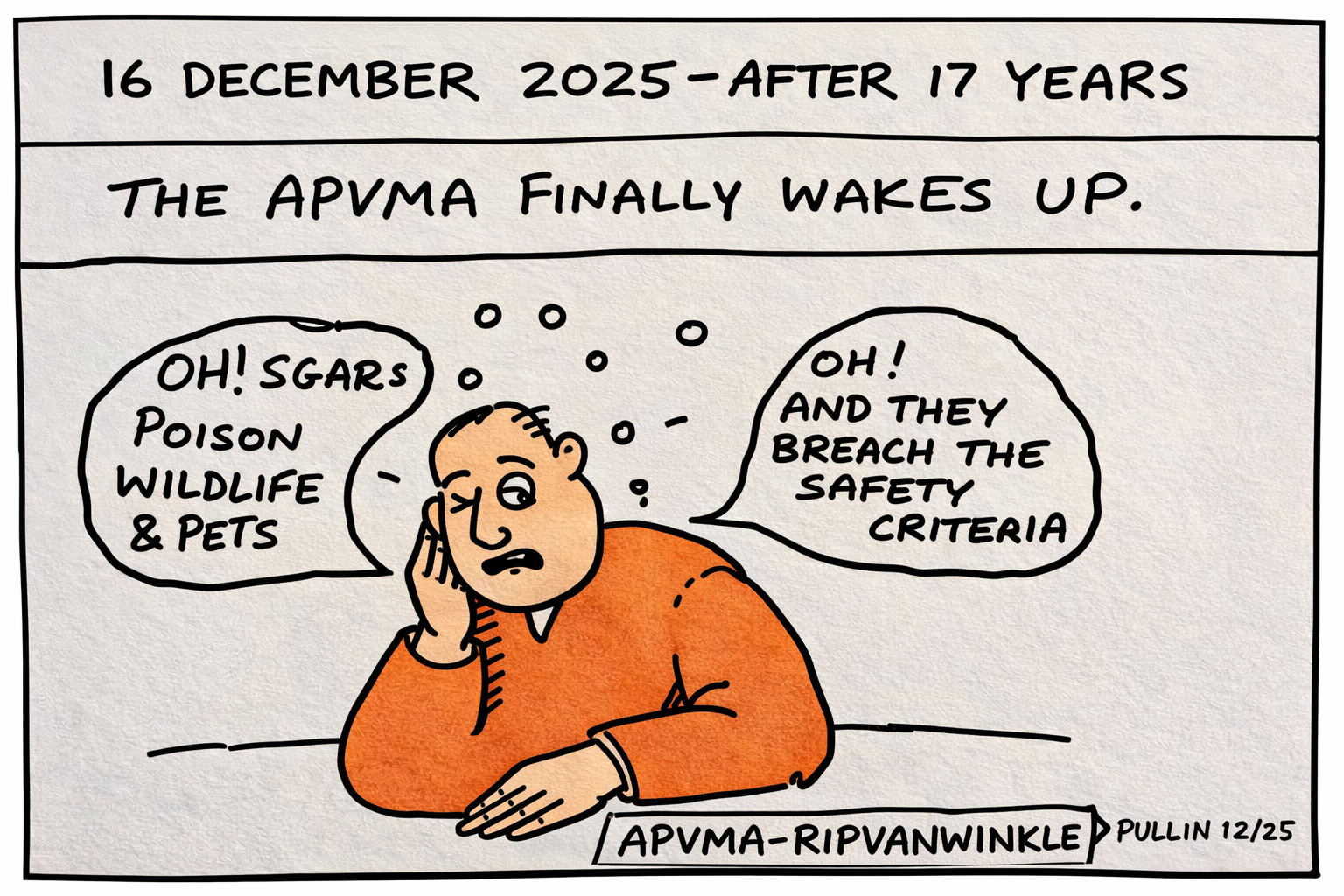
A review of regulations is underway
The regulatory body, the Australian Poisons and Veterinary Medicine Authority (APVMA), has conducted a review over many years and released proposed changes to regulations on the use of rodenticides.
The APVMA has recognised that Second Generation Anticoagulant Rodenticides (SGARs) pose an unacceptable risk by breaching safety criteria and poisoning non-target animals.
These proposed regulation changes won’t protect owls and wildlife from poisoning
The APVMA proposes to continue to allow sale of SGARs to the general public. It claims it will reduce the risk through various conditions, the main ones being changes to labels, requiring the use of bait stations and reducing the size of packs. Under Commercial listing, SGARs can also be used indoors and in outdoor bait stations by pest controllers and farmers.
But this won’t work to protect wildlife
Bait stations aren’t the answer. If a rat can enter, then any similar size or smaller animal such as a lizard, native rat or phascogale can access the bait too (primary poisoning).
Other birds and animals die from secondary poisoning through eating poisoned rodents. The rat will take days or weeks to die after eating bait, during which time it may return for more feeds to become a poison time-bomb before dying of internal bleeding. Wherever a bait is laid, indoors or outdoors, the rat won’t die there. In its weakened state it is easy prey. The owl eats the rat or returns to the nest to feed it to its chicks. It may become ill and die or become a road kill in its weakened state. How do concerned people stop this from happening?
Labelling is unlikely to work and some of the labelling suggestions are quite simply absurd, for example “DO NOT let…non-target animals eat poisoned mice”. How?
How will smaller pack sizes help if there are unlimited sales in smaller packets?
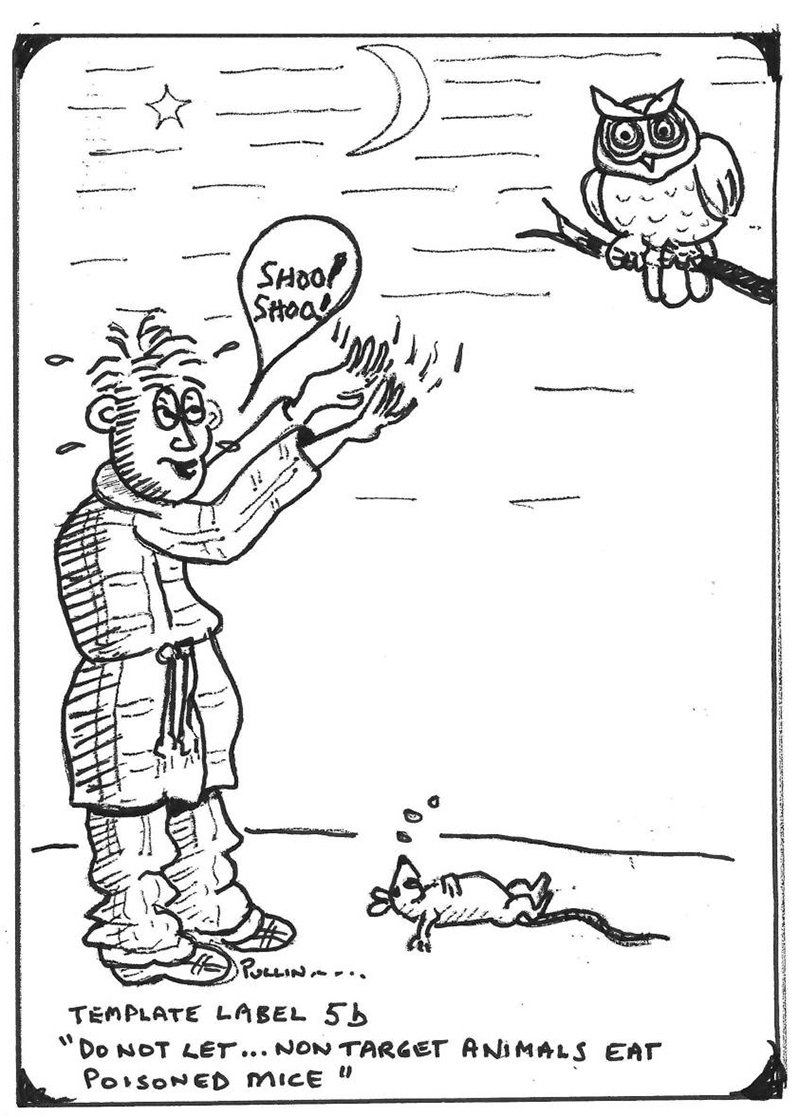
Cartoon Chris Pullin KC
Did you know these poisons are showing up right through the food web
Recent scientific research shows that rodenticides are throughout the food chain from reptiles, frogs and fish through to owls, eagles and endangered species such as Quolls, Chuditch and Tasmanian Devils.
Australia is lagging behind badly
Many countries have moved to ban SGARs from retail sale to the public. These include the USA, British Columbia in Canada, Germany, the Netherlands, Switzerland and Austria.
But how will I control rodents in my house or garden?
Don’t believe the hype! SGARs are not needed to manage rodent pests!
People in these countries are controlling pest rodents without SGARs by using old-fashioned and technologically advanced traps, ‘natural’ baits and safer rodenticides that are less harmful to birds, wildlife and pets. (SGARs may still be needed in special cases like carefully controlled eradication of rodents from conservation areas).
PLEASE ACT NoW To SAVE OUR OWLS
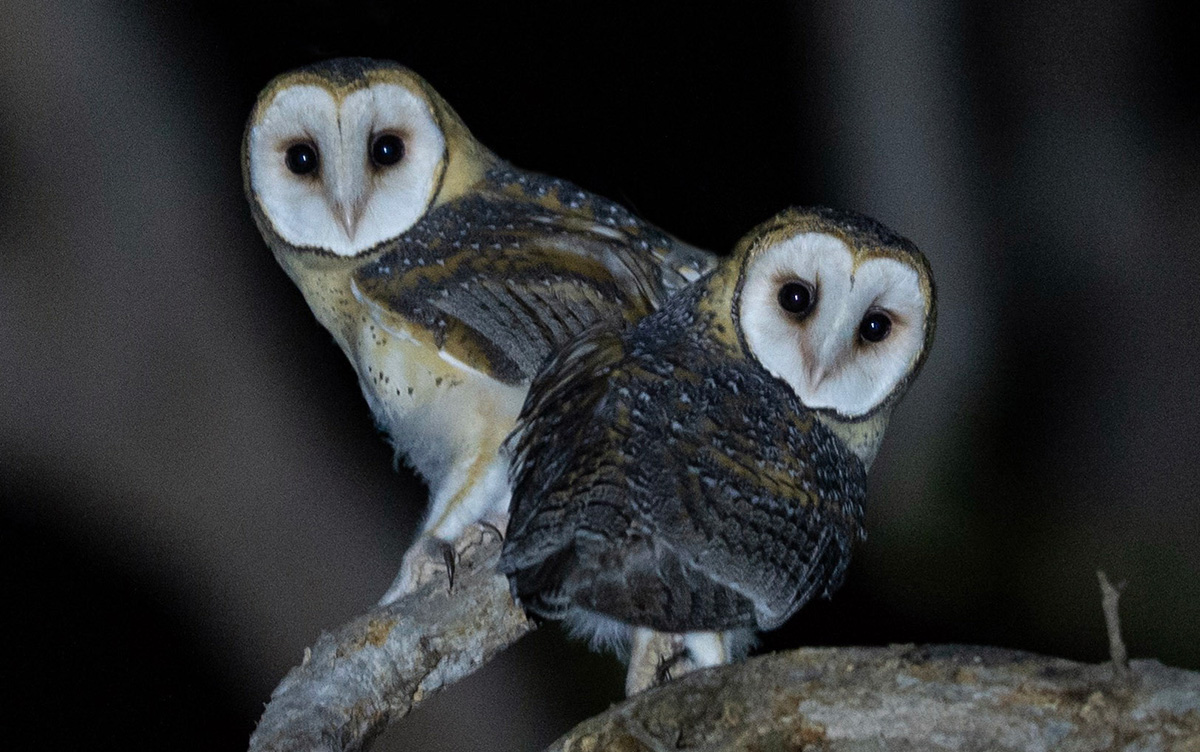
Photo Steve Castan
It is vital to remove SGARs permanently from public sale and ban their commercial use, except under strict regulations for conservation purposes.
While legislation is enacted to achieve this, an immediate moratorium must be placed on retail sale and commercial use of SGARs.
EMAIL THE PoLITICIAnS URGENTLY
Use or adapt the text below. The more personal you can make it, the more impact it will have e.g. personal experience of treating, rehabilitating or death of birds, other wildlife or loved pets, or your involvement in wildlife conservation.
Cut and paste into the email.
One SEND will email three Politicians:
- Senator Murray Watt, Minister for the Environment and Water
- Hon Julie Collins MP, Minister for Agriculture, Fisheries and Forestry
- Senator Anthony Chisholm, Assistant Minister for Agriculture, Fisheries and Forestry
Owl poisons should be banned
I ask that you intervene to ensure that the extremely harmful “second generation anticoagulant rodenticides” are banned from retail sale and from commercial use except for strictly regulated conservation purposes.
While legislation is enacted to achieve this, an immediate moratorium must be placed on retail sale and commercial use of SGARs.
I write to you because ——. My lived experience is —- ADD YOUR OWN DETAILS
I am angered that current proposals by the APVMA to legislate controls on the use of anticoagulant rodenticides completely fail to protect Australia’s precious wildlife including endangered species such as Powerful Owls, Tasmanian Wedge-tailed Eagles, Tasmanian Devils and Quolls.
The decision by the APVMA to continue retail sale and commercial use of SGARs ignores peer reviewed science.
Is the APVMA, having recognised that SGARs pose an unacceptable risk by breaching safety criteria and poisoning non-target animals, breaching their responsibilities under their legislation?
The APVMAs media release claiming sweeping changes is entirely misleading. Their proposed measures will not achieve the intended outcome.
- Given that poisoned rodents leave a bait station and sicken and die elsewhere over many days, placing baits in outdoor bait stations will do nothing to prevent secondary poisoning of wildlife.
- It is not possible for people to effectively achieve label instructions: “DO NOT let…non-target animals eat poisoned mice”. (Template label 5b) or collect and dispose of rodent carcasses.
- Unlimited poison in smaller packets will not prevent poisoning of wildlife including endangered species.
MAKE A SUBMISSION To THE APVMA BEFoRE 16 MARCH 2026
Email your submission to chemicalreview@apvma.gov.au
or send it by snail mail to:
Chemical Review
Australian Pesticides and Veterinary Medicines Authority
GPO Box 574
Canberra ACT 2601
Copy your submission to:
Senator Murray Watt, Minister for the Environment and Water minister.watt@dcceew.gov.au
WHAT To InCLUDE In YoUR SUBMISSIOn
When preparing your written submission, include the following required elements:
- Contact name
- Company or group name (if relevant)
- Postal address
- Email address
- Date of your submission
- Reasons for your comments — clearly explain your views on the proposed regulatory decisions and provide supporting evidence where possible (scientific information, references, data) and indicate your sources.
- Include a public submission cover sheet, which gives you options for how your submission will be published (including confidentiality requests). You can find this at https://www.apvma.gov.au/news-forms-and-publications/forms/public-submission-coversheet
SUGGESTIOnS To HELP YoU MAKE YoUR SUBMISSIOn
It is vital to remove SGARs permanently from public sale and ban their commercial use.
Here are some points you could include. The information above will help you back up your statements.
- I am angered that current proposals by the APVMA to legislate controls on the use of SGARs fail to protect wildlife.
- SGARs should never be used indoors or in outdoor bait stations by ANYONE – public, farmers or Pest Controllers.
- I am deeply concerned that the APVMA review process was flawed.
i. The APVMA has ignored countless peer-reviewed and published scientific studies and expert deputations in the review. Does the APVMA not trust Australian scientists? Do they think scientists are incompetent or dishonest?
ii. The APVMA has demonstrated a lack of scientific rigour and understanding of animal behaviour underpinning proposals relating to bait stations and labelling. Will the APVMA now take account of scientific evidence about poisoning pathways?
iii. Is the APVMA, having recognised that SGARs pose an unacceptable risk by breaching safety criteria and poisoning non-target animals, breaching their responsibilities under their legislation? Their proposed measures will not achieve the intended outcome.
iv. Why has the APVMA failed to take account of relevant USA EPA legislation that has been in place for many years?
v. Will the APVMA, in recognition of scientific evidence, remove SGARs permanently from public sale and ban their commercial use.
vi. Why has the APVMA failed to propose any means of monitoring current rodenticide harm to wildlife and a program to determine whether actions resulting from this review are reducing poisoning of wildlife, pets and people? - A more integrated approach such as a National Stewardship Program and Integrated Pest Management are the direction modern pesticide regulation is moving internationally. The APVMA already has the statutory power to implement or require these measures for rodenticides under the AgVet Code.
i. I urge the APVMA to create a National Stewardship Program to perform tasks such as: review training and certification courses for professional pest controllers, implement and fund wildlife-monitoring programs, and create an online reporting tool for alleged instances of non-compliance.
ii. The APVMA should promote safer, wildlife-friendly alternatives, including mechanical or electronic traps and non-anticoagulant options that pose lower risks to wildlife and pets.
iii. The APVMA should recommend Integrated Pest Management strategies that prioritise non-anticoagulant control methods (e.g. owl nest boxes to support owls that eat rodents) for rodent management.